Correspondence matching
Identifying each candidate signal: final outputs
Each candidate signal can be identified uniquely in a file by it’s channel number, and its index position within the channel. (Remember, in Python indexing starts with 0). So, for instance, let’s take this example candidate signal array:
[ [(0.1,0.3),   (0.5,0.8),   (0.9,1.2)],
  [(0.15,0.35), (0.23, 0.45)          ],
  [(0.2,0.9),   (.9,1.2),  (1.23,1.26)],
  [(0.1,0.7),   (1.,1.1),  (1.29,1.38)]
]
Each candidate signal in the array above will have the following identities:
[ [ (0,0),   (0,1),   (0,2) ],
  [ (1,0),   (1,1)          ],
  [ (2,0),   (2,1),   (2,2) ],
  [ (3,0),   (3,1),    (3,2) ]
]
The final outputs will be a ‘set’ of calls which have been matched, the set name is based on the ID of the call in the reference channel (this may/not be a good idea…what if the ref. channel doesn’t have good detections or the detection quality changes over time..).
matched_sounds = {(3,0):set([(0,0), (1,0), (2,0)]),
                  (3,1):set([(0,1), (1,1), (2,1)]),
                  (3,2):set([(0,2),       (2,2)])
                 }
Not all detections will necessarily be matched with another detection in all channels. Sometimes, this might be due to failure of the matching algorithm and sometimes it might be due to the directionality of the source sound. In the example above the sound (3,1) doesn’t have a match on channel 2, and this means that particular sound can’t be localised even though it has been detected.
Technical details and open questions
The
Important variables
Maximum distance from reference mic to other mics
Inter-sound interval
Sound duration
Scenarios to handle
The most important thing to check is if correspondence matching based on the max array distance works. It will work when there are few sounds, and these sounds are spaced far apart in time.
Easy case: when all signals are detected well
Then it’s mostly just a question of matching the first sounds across all channels, and then the second, and so on till all N sounds have been matched. Though, even here - there can be issues if there is even a single call that’s not been detected.
Calculate the max distance between mics, and convert this into a maximum \(\pm \Delta T\) delay between mics.
This \(\pm \Delta T\) may never actually appear in the dataset though because often the mics are located in places far away from the sources. The max \(\pm \Delta T\) also assumes that the sources are literally beaming sound exactly in line from one mic in the farthest distance pair, to the other mic. Anyway, the idea would be to generate paired \(\pm \Delta T\) windows for every mic pair, and see which sounds fall satisfy all/most of the delay windows. These are valid sources for a given detection.
Not so easy cases: high ‘signal density’
What happens when the inter-sound interval drops below that of the max-array distance, and which rules work better then?
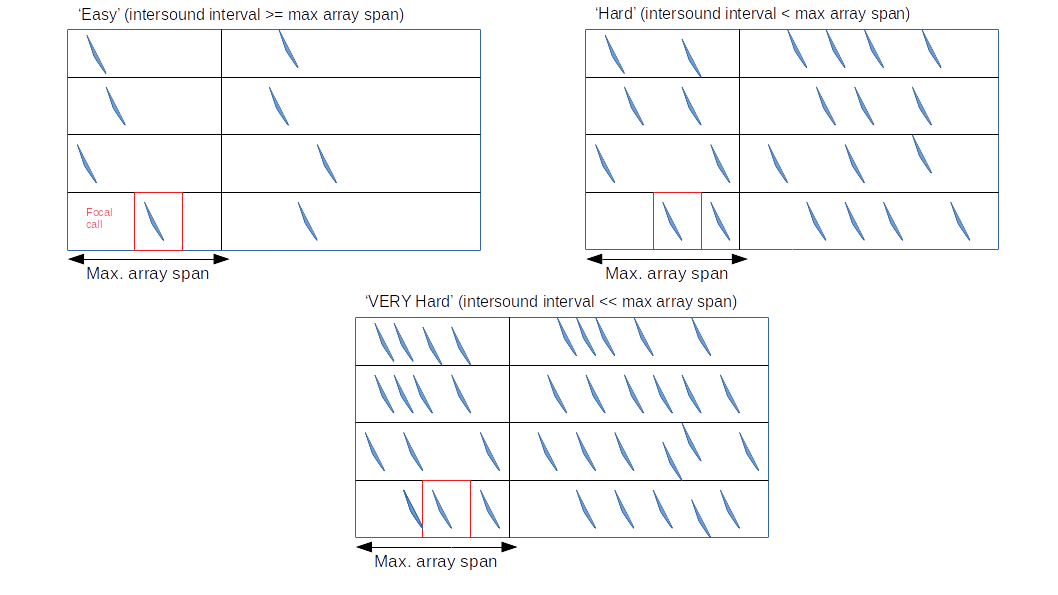
Not so easy cases: high signal density and similar sounds
Aside from the inter-sound arrival, there’s also the question of signal similarity. How to deal with the case where the sounds are
Unique –> this is the ‘easy’ case, as any given image-base algorithm should be able to match the sounds correctly
(Effectively) the same –> this is the ‘tough’ case, where algorithms may have a tough time.
Poor/Missed detections?
Possible solutions
Spectrogram cross-correlation?
Stereo image matching : Try and use established algorithms from image analysis/ structure-from-motion/etc. to generate matches across the different calls and channels using spectrogram representations. One of the issues is that these matching algorithms are built with rotational invariance in mind – which might mess things up.